Posts

Cactus Jack [aka The Villain] (US, 1979); Dir. Hal Needham

Image
Sometimes you want to go right back to the beginning; before it became complicated, before all the doubts, disappointments and cynicism. When every day felt new and different yet comfortingly the same. Although I was born in London my earliest memories are of High Wycombe in Buckinghamshire. I can just about recall standing with my mum beside my sister's cot when I was two years old, nearly three. Gradually the impressions grow more substantial; Christmases and birthdays, my first day at school (what a miserable old git that headmaster was), climbing to the top of the apple tree in our back garden, finishing third in a race on sports day because, while in the lead, I'd stopped to watch my fellow competitors! It feels so vivid and real compared to later years and perhaps a part of me died when we moved away the summer before I turned eight. I know I'd never feel quite so sure of myself again.  Maybe that's why I've felt the urge to revisit it a couple of times in...

AFED #135: Kaidan chibusa enoki [Ghost of Chibusa Enoki, aka The Mother Tree] (Japan, 1958); Dir. Gorô Kadono

Image
Although Japanese supernatural horror might nowadays lead one to think of stories about cursed videotapes and spectral emo girls who can't keep their hair out of their faces, these are only recent manifestations of a tradition that's several hundred years old. Japanese ghost stories, or kaidan , first emerged during the Edo period in the seventeenth century, adapted and inspired by earlier Chinese ghost stories. Typically they revolve around vengeful spirits who return to redress a wrong committed against them in their mortal lives, or sometimes with a general grudge against humanity. Kaidan have inspired two of Japanese cinema's most celebrated films - Kobayashi's Kwaidan and Mizoguchi's Ugetsu - but there are numerous other lesser works that draw upon this heritage. During the fifties the Shintoho, a short-lived studio founded by former employees of the more famous Toho Co, produced a series of modest kaidan films, one of which was The Mother Tree ... Thi...

AFED #123: Hôtel Terminus: The Life and Times of Klaus Barbie (France/US, 1988); Dir. Marcel Ophüls

Image
Marcel Ophüls' Oscar-winning documentary is a sprawling epic that seeks answers to questions both factual and philosophical. Through a composite of dozens of interviews with subjects in France, Germany and the Americas he builds a portrait of the career of Barbie, the Nazi war criminal dubbed the Butcher of Lyon, perhaps most infamous for his capture and torture of the French Resistance leader Jean Moulin. The director's diligent efforts to get to the bottom of the Moulin affair, and who may or may not have exposed him to the Nazis, make up much of the first half of the four and half hours. Even forty years after the event the wounds and recriminations continue to fester in the survivors and the testimonies suggest that the matter of collaboration is not quite as clear as one might imagine. It also touches upon Barbie's formative years and the first-hand accounts of those who suffered from his sadistic interrogation techniques. Yet perhaps more astonishing are the disc...

AFED #122: The Man Who Laughs (US, 1928); Dir. Paul Leni

Image
Given the high regard in which it's held I perhaps had unfair expectations of The Man Who Laughs . Based on Victor Hugo's novel of the same name, like his more celebrated Notre-Dame de Paris it's a historical melodrama with gothic overtones. In the hands of director Paul Leni it becomes an atmospheric romance that sanitises the German Expressionist aesthetic. Although it's actually one of the earliest Universal pictures to incorporate sound elements it has the opulent production standards typical of silent films during this period, with some elaborate sets depicting 18th century London and the court of Queen Anne. But at nearly two hours the story seems stretched to the point of tedium and the characters lack the depth or complexity to make them engaging. Yet Conrad Veidt, an actor who comfortably ranks amongst my all time favourites, delivers a sensitive performance as Gwynplaine, the unfortunate hero who is disfigured as a child in an act of revenge against his ...

AFED #121: Paprika (Japan, 2006); Dir. Satoshi Kon

Image
If you wonder where Christopher Nolan found his inspiration for Inception then look no further. The wunderkind writer/director has readily acknowledged that Satoshi Kon's 2006 anime was an influence and not only do they share the same premise - that of being able to share other people's dreams - but certain images were directly copied. That's not a slight towards Nolan and Kon's own influences, such as the work of author Philip K. Dick, are readily apparent here in this story of a technological innovation that allows therapists to enter the dreams of their subjects. Inevitably it falls into the wrong hands and is put to malicious ends, resulting in a dream that spreads like a virus, blurring fantasy and reality. Like his earlier film Millenium Actress ( AFED #36 ) Kon allows his imagination to go to town with some astonishing sequences and truly hallucinogenic dream imagery. Unfortunately it also shares the flaw of sacrificing something in the way of coherence ...

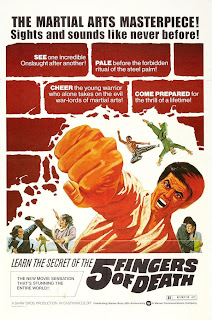
AFED #111: Shào Lín sān shí liù fáng [The 36th Chamber of Shaolin] (Hong Kong, 1978); Dir. Liu Ch-Liang; Tian xia di yi quan [aka King Boxer, aka Five Fingers of Death] (Hong Kong, 1972); Dir. Cheng Chang Ho

Image
Martial arts film are, it must be confessed, something of a blank area for me. Many years ago I recall being challenged by a friend when I suggested that Enter the Dragon was the best of this genre ever made. "You've never seen any others though," he pointed out. It's true, and until now I haven't made any attempt to redress this. So let's start with a double bill produced by Hong Kong's most famous studio, the redoubtable Shaw Brothers. The name is synonymous with Kung Fu and martial arts cinema, almost representing a genre within the genre, cranking out dozens of films a year during their heyday in the seventies. Modelled on the old Hollywood studio system, right down to the company logo (imitating that of Warners'), the company kept a stable of stars and directors under exclusive contract. It worked highly effectively although as the decade progressed Shaw would be eclipsed by a rough-and-ready rival, Golden Harvest, who launched the careers of...

AFED #109: Sanshō Dayũ [Sansho the Bailiff] (Japan, 1954); Dir. Kenji Mizoguchi

Image
Few national cinemas can boast the wealth of directing talent that Japan possessed between the forties and sixties. Yasujirō Ozu, Akira Kurosawa, Kenji Mizoguchi, Mikio Naruse and Masaki Kobayashi were all active during this golden age, producing some of the classics of world cinema. Mizoguchi, director of Sanshō Dayũ , is still something of a grey area for me as I've thus far only watched this and (his own favourite work) The Life of Oharu (1952). It shares with the theme of all fall from status, yet while Oharu's is partly of her own doing for the hapless characters of Sanshō Dayũ their fortunes are constantly governed by the fickle hand of fate. Taking place - like so many Japanese films of this vintage - during the feudal era, the story begins with the exiling of a virtuous governor to a far-off province. When his wife and children attempt to make the long journey to visit him they are tricked and find themselves sold into prostitution and slavery. The children, Anju...