Posts

Showing posts with the label Women Directors

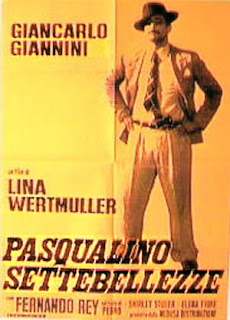
AFED #104: Pasqualino Settebellezze [Seven Beauties] (Italy, 1975); Dir. Lina Wertmüller
Image
Seven Beauties is a film I feel I ought to have liked, or at least appreciated, more than I did. It's an epic, picaresque satire that touches upon subject matter that was still sensitive at the time, but there's an ugliness to it which I found difficult to reconcile. After an introduction that soliloquises ironically about the rise and fall of Mussolini and the indignities of the Second World War over old wartime footage, the story begins in somewhere in Germany shortly after the collapse of Italian fascism. Pasqualino (Giancarlo Giannini) and Francesco are two Italian soldiers fleeing the Nazis. During conversation Pasqualino reveals that he killed a man before the war and the narrative shifts into flashback of his earlier life as a hustler and dandy in Naples, where his life revolved around protecting the honour of his seven sisters. After killing a man who attempted to pimp one of these 'beauties' (they're anything but beautiful) he evades execution by feign...
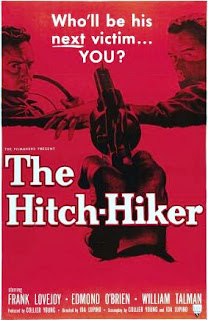
AFED #96: The Hitch-Hiker (US, 1953); Dir. Ida Lupino

Image
I wish I knew more about Ida Lupino, or at least had the time to research her career more thoroughly. I wasn't even aware until a few minutes ago that she was British by birth, and even trained as an actress  at RADA before heading to the States in the thirties. After working her way diligently through the ranks she progressed to more significant roles by the end of the decade, whereupon she began referring to herself with self-deprecation as "the poor man's Bette Davis". Perhaps her greatest legacy though was as a pioneering woman director whose modest output blazed a trail for future generations. After a handful of earlier issue-based pictures The Hitch-Hiker represented her first directorial foray into film noir, a genre she'd already graced in a number of films as an actress. It's a taut little thriller that utilises that mainstay of genre and exploitation cinema: the perils of travelling by car. I've touched upon this before, in relation to H...

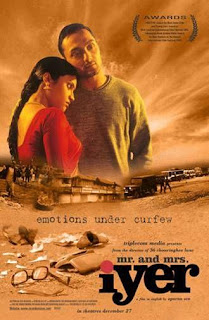
AFED #86: Mr. and Mrs. Iyer (India/US, 2002); Dir. Aparna Sen

Image
Although Bollywood cinema has risen in prominence in the west in recent years, the independent tradition, what's known as the Indian New Wave or Parallel Cinema, has a history that's nearly as long as its mainstream counterpart. Its most famous exponent is of course Satyajit Ray, whose Apu Trilogy remains one of the great landmarks of world cinema. But the independent tradition of making films that don't shy away from contemporary concerns and divisive issues continues - despite some ups and downs - to the present day. Released in 2002, Mr. and Mrs. Iyer , is an example of the more recent trend towards films made in English, presumably with an eye towards the international market. This perhaps accounts for some of its mildly expository tendencies, but that doesn't detract from a touching and sensitively told melodrama.   A road movie of sorts, it's the story of Meenakshi Iyer, a young Indian mother travelling with her baby son back to the city after a trip ...

AFED #71: Cold Light of Day (UK, 1989); Dir. Fhiona-Louise

Image
Sooner or later most infamous real-life crimes receive a dramatisation, but the timing of such treatments can vary enormously. Some cases, such as that of the Moors Murders, are granted a respectful distance (although See No Evil finally told the story for tv in 2006). Others, like that of Harold Shipman, can make it to the screen in just a couple years . American readers will know that over there the turnaround can be even quicker. Perhaps it owes something to the degree to which ordinary, middle-class society is offended or horrified by the crimes, or to what extent they simply feel a morbid curiosity. Film or television executives will seldom commission such a drama if there's any risk of a public backlash, even if it rarely equates to a drop in revenue (far from it). And occasionally independent producers have taken real-life crimes and crafted them into grimly effective films. One of the most notable (if sadly neglected) examples is The Black Panther (1977), a criminal...

AFED #66: Olympia (Germany, 1938); Dir. Leni Riefenstahl. The Wonderful, Horrible Life of Leni Riefenstahl (Belgium/UK/Germany, 1993); Dir. Ray Müller

Image
Leni Riefenstahl: evil Nazi film-maker or pioneering genius of pre-war cinema? Or perhaps both? Either way Riefenstahl remains probably the most influential woman film-maker ever. That's perhaps all the more remarkable because her reputation is principally due to two films, both documentaries. The first, Triumph of the Will is an account of the 1934 Nazi Party Congress in Nuremberg; a chilling work of propaganda that showcases Hitler's hypnotic genius and the spell he was casting upon the German people. Although a certain mystique has built up around this film and its sinister subtext in truth it's not the most compelling viewing to a contemporary audience. The more innovative of Riefenstahl's techniques - such as the use of telescopic lenses and aerial photography - were assimilated by the wider film-making fraternity, but many scenes drag interminably and lack subtlety. Her second, Olympia is generally viewed more sympathetically. An epic three and a half hour accou...

AFED #48: Italian for Beginners (Denmark, 2000); Dir. Lone Scherfig

Image
It's slightly unnerving when, at the start of Italian for Beginners , you see it was produced under the guidelines of Dogme 95 , the quasi avant-garde manifesto for film-making devised by renowned director Lars von Trier. Fortunately, while it presumably adheres to Dogme principles, that doesn't prevent director Lone Scherfig from telling a charming romantic comedy about misfits finding love in a small Danish town. Although the film is shot in a handheld verite style there's none of the detachment this approach can create. The story revolves around six lonely individuals, three men and three women, who all enroll to take Italian lessons at the local community centre. When their teacher rather inconveniently dies one of the group takes over his duties and they carry on. Gradually they pair off, two of the women discover they are actually long-lost sisters, and the story ends with a group trip to Venice. Although Scherfig didn't admit so at the time she'd actu...

AFED #40: Deadly Weapons (US, 1974), Double Agent 73 (US, 1974); Dir. Doris Wishman

Image
Back in the late eighties Jonathan Ross presented a series on Channel 4 that's pretty much the only worthwhile thing he's ever done. The Incredibly Strange Film Show ran for just twelve episodes and served as an introduction to all manner of weird and wonderful cult movies; everybody from Ray Dennis Steckler to George Romero. In those pre-internet days it was all but impossible to get hold of such films and the series gave a tantalising glimpse into a forbidden world. One episode in particular which lodged in my memory featured the work of Doris Wishman; most famous of which are the two films she made starring exotic dancer Chesty Morgan. Even as a pubescent 14 year-old I remember being more appalled than turned on by Chesty's 73FF-32-36 figure. I mean, all straight men will tell you that breasts are great but for most of us there are acceptable limits. Chesty - real name Lillian Wilczkowsky - was quite simply a freak and apparently happy to let herself be defined by t...

AFED #35: Beau Travil (France, 1999); Dir. Claire Denis

Image
I didn't realise while watching it that Claire Denis's Beau Travil was a loose adaptation of Herman Melville's Billy Budd , but wasn't terribly surprised. Beneath the oblique veneer lies a nineteenth century morality tale in a military setting vaguely reminiscent of Tolstoy. The story is relocated to the present day and a regiment of French Foreign Legion troops stationed in Djibouti. Galoup (Denis Lavant), a committed but somewhat sullen staff sergeant, develops a festering jealousy towards Sentain, a popular and good looking new recruit. When Sentain is awarded a medal for bravery in the wake of a helicopter accident Galoup's hatred only grows and he begins trying to unsettle his rival. When an opportunity finally presents itself to discipline Sentain, Galoup takes it too far and destroys his own career. For long stretches very little takes place; much of the narration is told through Galoup's voiceover and the dialogue is sparse; a great deal imparted ...

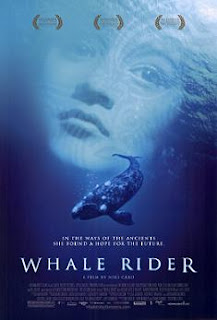
AFED #28: Whale Rider (New Zealand, 2002); Dir. Niki Caro

Image
When we watch a film we enter into an unwritten contract that we're willing to be manipulated. Be it sympathy, happiness, sadness, anger, fear, lust or any combination of these; if the film-maker is skillful they'll succeed in delivering at least some of us to that emotional state. We accept that their intentions are more or less benign and go along for the ride. That manipulation doesn't always sit quite so comfortably afterwards, when reason resumes control. Traditionally the works which are singled out for criticism or censorship are those more extreme films which, according to our moral guardians, have the tendency to 'deprave and corrupt'. But there's another kind of film that can be equally ruthless; those which seek to speak to our inner child and the unresolved issues we never quite put aside. Where is this coming from? Well, because at the end of Niki Caro's Whale Rider I cried, which - being a jaded cynic - isn't a common occurrence. ...

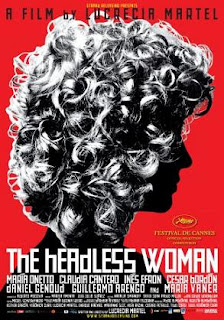
AFED #20: La Mujer Sin Cabeza [The Headless Woman] (Argentina, 2008); Lucrecia Martel

Image
Latin American cinema is almost a complete mystery to me. To the best of my knowledge the sum total of my viewing consists of Amores Perros , City of God and Santo vs. The She-Wolves . I was hoping I could also include El Perro , a rather odd seventies picture in which The Exorcist 's Jason Miller plays a fugitive chased across Venezuela by a relentless dog; but it turns out to have been a Spanish production.  Either way, you can see it's not exactly an impressive return. Yet the consensus amongst film critics and scholars is that the region has made huge strides in the past decade, even if the general English-speaking public aren't paying much attention. That Mexico, Brazil and Argentina now have prospering national cinemas is perhaps not so surprising, but Chile and Uruguay are also getting in on the act. Of course it's all relative and Hollywood still dominates at the box office. It would be remiss if at least a handful of the intended (but don't count on ...