Posts

Showing posts with the label Japanese

AFED #135: Kaidan chibusa enoki [Ghost of Chibusa Enoki, aka The Mother Tree] (Japan, 1958); Dir. Gorô Kadono

Image
Although Japanese supernatural horror might nowadays lead one to think of stories about cursed videotapes and spectral emo girls who can't keep their hair out of their faces, these are only recent manifestations of a tradition that's several hundred years old. Japanese ghost stories, or kaidan , first emerged during the Edo period in the seventeenth century, adapted and inspired by earlier Chinese ghost stories. Typically they revolve around vengeful spirits who return to redress a wrong committed against them in their mortal lives, or sometimes with a general grudge against humanity. Kaidan have inspired two of Japanese cinema's most celebrated films - Kobayashi's Kwaidan and Mizoguchi's Ugetsu - but there are numerous other lesser works that draw upon this heritage. During the fifties the Shintoho, a short-lived studio founded by former employees of the more famous Toho Co, produced a series of modest kaidan films, one of which was The Mother Tree ... Thi...

AFED #121: Paprika (Japan, 2006); Dir. Satoshi Kon

Image
If you wonder where Christopher Nolan found his inspiration for Inception then look no further. The wunderkind writer/director has readily acknowledged that Satoshi Kon's 2006 anime was an influence and not only do they share the same premise - that of being able to share other people's dreams - but certain images were directly copied. That's not a slight towards Nolan and Kon's own influences, such as the work of author Philip K. Dick, are readily apparent here in this story of a technological innovation that allows therapists to enter the dreams of their subjects. Inevitably it falls into the wrong hands and is put to malicious ends, resulting in a dream that spreads like a virus, blurring fantasy and reality. Like his earlier film Millenium Actress ( AFED #36 ) Kon allows his imagination to go to town with some astonishing sequences and truly hallucinogenic dream imagery. Unfortunately it also shares the flaw of sacrificing something in the way of coherence ...

AFED #109: Sanshō Dayũ [Sansho the Bailiff] (Japan, 1954); Dir. Kenji Mizoguchi

Image
Few national cinemas can boast the wealth of directing talent that Japan possessed between the forties and sixties. Yasujirō Ozu, Akira Kurosawa, Kenji Mizoguchi, Mikio Naruse and Masaki Kobayashi were all active during this golden age, producing some of the classics of world cinema. Mizoguchi, director of Sanshō Dayũ , is still something of a grey area for me as I've thus far only watched this and (his own favourite work) The Life of Oharu (1952). It shares with the theme of all fall from status, yet while Oharu's is partly of her own doing for the hapless characters of Sanshō Dayũ their fortunes are constantly governed by the fickle hand of fate. Taking place - like so many Japanese films of this vintage - during the feudal era, the story begins with the exiling of a virtuous governor to a far-off province. When his wife and children attempt to make the long journey to visit him they are tricked and find themselves sold into prostitution and slavery. The children, Anju...

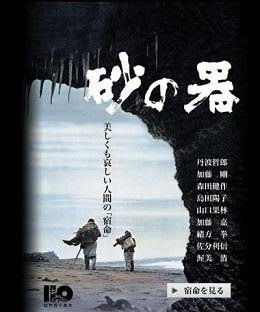
AFED #45: Suna no utsuwa [Castle of Sand] (Japan, 1974); Dir. Yoshitaro Nomura

Image
As a rule most films stick to a particular pitch or tone when telling a story. The pacing may rise or drop, there may be quirks or twists, but you can usually be fairly confident what kind of film you're watching after the first five or ten minutes. Even when the script takes a detour into the strange its usually given some kind of foreshadowing. But when the style suddenly shifts dramatically our fondest held notions of classical aesthetics are rather rudely challenged. Imagine you were watching a stirring account of the brutality of trench warfare in 1917 when an hour into the film without explanation a talking panda suddenly turns up in a time machine. You'd feel perplexed, perhaps even a little angry. Granted, if you'd heard or read about what to expect beforehand it might not be such a surprise, but that was almost how I felt when watching Yoshitaro Nomura's Castle of Sand . It's a film that moves the goal posts a couple of times during its 142 minutes and...

AFED #36: Millenium Actress (Japan, 2001); Dir. Satoshi Kon

Image
A few days ago I reviewed Ozu's Late Spring , starring the legendary actress Setsuko Hara. Widely regarded in Japan as one of, if not the finest talent of her generation Hara shocked the nation when she decided to retire from the profession in her mid-forties shortly after Ozu's death, bluntly stating that she had made enough money to support herself and simply didn't care to continue. Since that time Hara has lived as a recluse and gradually a mystique has built up around her, perhaps due to the fact we romanticise the arts and can't fathom how anybody could regard acting as merely a job. But I was intrigued to discover that her life had served as partial inspiration for a feature length anime, Millenium Actress , and naturally had to seek it out. Made by anime director and cartoonist Satoshi Kon, who died last year, it explores precisely that theme of how we project biographical legend upon an artist's body of work, blurring fantasy and reality. Tachibana,...

AFED #32: Banshun [Late Spring] (Japan, 1949); Dir. Yasujiro Ozu

Image
I'm starting to wonder why I'm doing this. Every day I'm putting myself through the wringer to watch films and write some very average material, and while I'm grateful to anybody who does take the time to read it I'm not sure I would in the same position. Depression takes a hell of a lot out of you, all the best laid plans and ambitions feel like pissing in the wind and the world feels so cheap and tawdry. You want to believe it's a good place but down here in the foothills (or is it the gutter?) it's difficult to see very much. Then there's my choice of films, as the point has been made to me that I could attract a lot more visitors and general interest in what I'm doing if I reviewed more mainstream material; the kind of stuff the average moviegoer is interested in. Yet aren't there thousands of other sites and blogs doing exactly the same thing? What does it profit a man if he gains more visitors but loses his soul? No, better to plough ...

AFED #14: Pistol Opera (Japan, 2001); Dir. Seijun Suzuki

Image
During a short interview that's included as an extra on the dvd of Pistol Opera , director Seijun Suzuki is asked what the film means to him as a director. "Such a stupid question," he retorts. "What does making this interview mean to you?" It was the influential French film journal Cahiers du Cinema that first popularised the notion a film's director should be credited as its primary creative influence in the mid fifties. Although applicable to all cinema, some of the most enthusiastic writing on the auteur theory concerned directors who had worked within an integrated studio system, in particular that of classical Hollywood. While Francois Truffaut and his Cahiers cohorts were extolling the virtues of Alfred Hitchcock and Howard Hawks, at the Nikkatsu Company in Japan a young director was just beginning his career. Within a decade Seijun Suzuki had taken the helm of more than thirty B-movies for the studio, demonstrating a particular aptitude for ga...