Posts

Showing posts with the label Czechoslovak

AFED #103: Limonádový Joe aneb Koňská opera [Lemonade Joe] (Czechoslovakia, 1964); Dir. Oldřich Lipský

Image
I was commenting just a couple of weeks ago (with regard to Sexmission ) how eastern European comedy comes across as very broad and affected to western sensibilities, at least during the Cold war era. Probably the closest we've seen to an English language film done in the same style would, for obvious reasons, be Polanski's The Fearless Vampire Killers , which for all its visual flair and Komeda's wonderful score falls rather flat with the slapstick pratfalls. As I mentioned last time the prominence of this kind of humour probably owed a lot to the censorious climate, where more subversive wit was usually frowned upon. A good example of this is Milos Forman's The Fireman's Ball , which although not especially radical by our standards was criticised in Czechoslovakia for its veiled attack on the petty bureaucracy of communism. No such ire was directed towards Lemonade Joe , which was released a few years earlier; perhaps because it does precisely the opposite ...
AFED #77: Rozmarné léto [Capricious Summer]; (Czechoslovakia, 1968); Jiří Menzel

Image
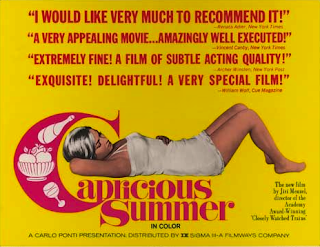
What's this, another Czechoslovak film already? Indeed, but I'll make no apologies for my endless fascination with cinema from that corner of Europe and have just come into possession of a pile of films from there, hence my choice. My journey into Czech cinema didn't really begin until three or four years ago. It could have been different; I'd first encountered Jiří Menzel's debut film, Ostře sledované vlaky [ Closely Watched Trains ] in 1995 - as part of a season of 100 films the BBC were showing to commemorate the centenary of the moving image - but for whatever reason it failed to impress. Although wry humour pervades, it's stark monochrome felt bleak and depressing and I had no stomach for a coming of age drama that morning I watched it as a nineteen year-old. So although I've watched dozens of Czechoslovak films since then, I've steered clear of Menzel's work despite its canonic position in the New Wave. Today's film could be seen as an...

AFED #74: Ikarie XB-1 (Czechoslovakia, 1963); Dir. Jindřich Polák

Image
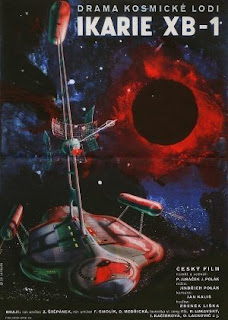
Said to have been an influence on Kubrick's 2001: A Space Odyssey , Czech sci-fi Ikarie XB-1 demonstrates both a debt to its American cousins and a willingness to do things a little differently. The eponymous 'Icarus XB-1' is an exploratory spaceship in the 22nd century, with a mission to go boldly go where no man has gone before, namely Alpha Centauri. Manned by a large mixed crew of various skills, their journey is scheduled to take some fifteen earth years; although because of "time dilation" only two years will pass for those on board. The earlier part of the film focuses on the humdrum details of life on board the ship, which gradually gives way to frustration and cabin fever as time wears on. Just when you've started to wonder whether anything of significance is ever going to happen, they encounter a derelict twentieth century vessel armed with nuclear weapons. When it explodes, killing two members of the Icarus's crew in the process, our enlig...

AFED #51: Císařův slavík [The Emperor's Nightingale] (Czechoslovakia, 1949); Dir. Jiří Trnka

Image
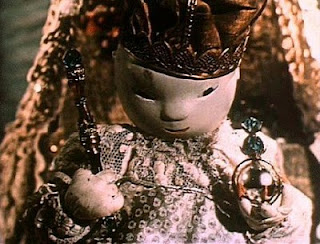
Jean Cocteau once said of the Czech animator Jiří Trnka that "the very name conjures up childhood & poetry". Sadly to most people the Trnka's name is only likely to draw a blank expression, but in animation circles his standards of excellence once drew comparisons with Disney. The son of a plumber, Trnka first achiewed renown as a painter and childrens' illustrator and didn't begin animating until the age of 33. His earliest shorts were cell-based, but it was with stop motion, or puppet animation, that he emerged as an original voice, adapting the distinctive style of his illustrated work to the three dimensional medium. With Czechoslovakia now under Communist rule in those post-war years, animation enjoyed state patronage and a degree of creative freedom not allowed to feature films with their wider audiences. Unlike the industrialised production methods of Disney et al, Trnka worked in a small studio, personally supervising the entire process. His work i...

AFED #24: Witchhammer [Kladivo na čarodějnice] (Czechoslovakia, 1969); Dir. Otakar Vávra

Image
At the time of writing, director Otakar Vávra is a month short of celebrating his 100th birthday. Yet even in 1969, when he shot this adaptation of Václav Kaplický's novel of the same name about the Northern Moravia witch trials, he was considered one of Czech cinema's old guard. Witchhammer (or Witches' Hammer , as it's sometimes known) doesn't fit entirely comfortably in the Czech New Wave canon, although Vavra himself was instrumental in the movement. As a lecturer at the state film school FAMU (Film Faculty of the Academy of Dramatic Arts) his open-minded philosophy encouraged the likes of Vera Chytilova ( Daisies )and Jaromil Jireš ( Valerie and Her Week of Wonders ) to innovate and push the boundaries. His own films, taking this as indication, tend towards a more grounded approach, although by no means as reserved as some of his contemporaries. Starkly shot in black and white, Witchhammer tells the story of Boblig von Edelstadt, a ruthless inquisitor ...

AFED #10: Adéla ještě nevečeřela [Dinner for Adele] (Czechoslovakia, 1977); Dir. Oldřich Lipský

Image
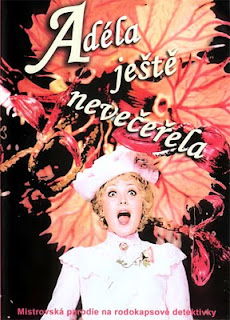
The 1970's was a strange period for Czechoslovak cinema, the one-time darling of critics and festival goers. Although the Soviet invasion of Prague in August 1968 marked the beginning of the end for the cycle of films known as the Czech New Wave, the wealth of talent creative talent nurtured during this period didn't simply disappear into the ether now that the authorities started keeping a closer eye on their activities. A few, most famously Milos Forman, defected to the West but for most it was a case of adapting to the new status quo. Perhaps unsurprisingly comedy and fantasy, always a vibrant component of the Czechoslovak film scene, assumed renewed significance as a creative outlet. Works such as bizarre time travel comedy Zítra vstanu a opařím se čajemor ('Tomorrow I’ll Wake Up and Scald Myself with Tea') or Juraj Herz's Beauty and the Beast adaptation Panna a netvor may not have had the same subversive intent of their predecessors but still show a natio...