Posts

Showing posts with the label Horror

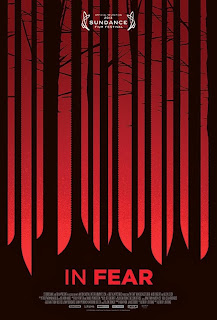
In Fear (UK, 2013); Dir. Jeremy Lovering
Image
Horror, perhaps more than any other, is a genre of simple pleasures. The same tried and tested formulas can be repurposed ad infinitum  with a reasonable chance of decent renumeration, even in cases where a franchise should have long since succumbed to the law of diminishing returns. For the discerning fan of horror cinema the devil is in the detail; how skilfully does a film plunder those too-familiar old tropes and, if not give the appearance of being fresh, at least demonstrate enough command of the material that the viewer doesn't think about it too much? So to point out the influences on Jeremy Lovering's debut feature film would both spoil the plot and be somewhat glib, because there's no question that In Fear is as smartly directed piece of work that deserves an audience. Tom (Iain De Castecker) and Lucy (Alice Englert), a young couple only a fortnight into their relationship, travel to rural Ireland for a music festival. En route to a nearby hotel they sto...

Bloody Blow (Canada, 2012); Dir. Rémy Couture & Joseph Elfassi

Image
The other day I received a message from a young friend. She's an inquisitive girl a penchant for controversial material; be it Charles Manson's curtailed music career, accounts of the  Brooklyn Vampire  or the writings of Satanic supercrank Anton Lavey. Anyway, she sent me a link to the short film I've embedded above and wanted my impressions. Being an egotist who hides behind a facade of false modesty I was of course happy to oblige. I'll confess that beforehand I'd never heard of Rémy Couture, the French Canadian filmmaker and special effects artist who was arrested in 2009 on charges of obscenity relating to a series of extreme horror shorts he'd made a few years before and made available on his website innerdepravity.com. His trial has already been adjourned a number of times but is currently scheduled to start in December 2012. Couture's oeuvre, so to speak, explores the transgression of taboos. He's steeped in horror...

Storage 24 (UK, 2012); Dir. Johannes Roberts

Image
Well, it finally happened: I got to see a Johannes Roberts film at my local cinema. If somebody had told me this when I sat shaking my head in dismay at the singular incompetence of Sanitarium I wouldn't have credited it. Hopefully it's not the end of the journey but he appears to have arrived somewhere. Storage 24 is a nuts and bolts sci-fi exploitation movie. The premise is a simple one: a US cargo plane has crashed somewhere in London, possibly shot down, for reasons unknown. Part of the wreckage has landed in the grounds of the titular secure storage warehouse, including a mysterious container which has broken open, releasing a nasty monster which seeks refuge in the building. It also causes a power failure, meaning that those who happen to venture inside - including Noel Clarke, the girlfriend he's just acrimoniously split from and attendant friends - find themselves trapped in there with the beast. We've seen it all many times before of course, from T...

AFED #135: Kaidan chibusa enoki [Ghost of Chibusa Enoki, aka The Mother Tree] (Japan, 1958); Dir. Gorô Kadono

Image
Although Japanese supernatural horror might nowadays lead one to think of stories about cursed videotapes and spectral emo girls who can't keep their hair out of their faces, these are only recent manifestations of a tradition that's several hundred years old. Japanese ghost stories, or kaidan , first emerged during the Edo period in the seventeenth century, adapted and inspired by earlier Chinese ghost stories. Typically they revolve around vengeful spirits who return to redress a wrong committed against them in their mortal lives, or sometimes with a general grudge against humanity. Kaidan have inspired two of Japanese cinema's most celebrated films - Kobayashi's Kwaidan and Mizoguchi's Ugetsu - but there are numerous other lesser works that draw upon this heritage. During the fifties the Shintoho, a short-lived studio founded by former employees of the more famous Toho Co, produced a series of modest kaidan films, one of which was The Mother Tree ... Thi...

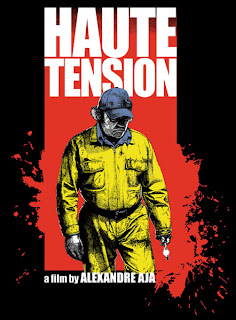
AFED #108: Haute Tension [High Tension, aka Switchblade Romance] (France, 2003); Dir. Alexandre Aja

Image
There's a gimmick that's gained prominence in cinema over the past decade that I find increasingly irksome. It cropped up in La casa muda just last week and here it is again, albeit Haute Tension preempted the Uruguayan film by several years. Let's call that gimmick EYTYKIW: Everything You Think You Know Is Wrong. Now EYTYKIW is a somewhat different creature to the twist ending, which has been with us ever since cavemen began sitting around the fire telling stories. Twist endings are the final snap in a story, a little surprise to muse over afterwards. By contrast EYTYKIW typically comes at some point during the third act and gleefully exposes the artifice of narrative; those logical assumptions we've made while reading or watching a story. The interesting thing about EYTYKIW is it can be effective without necessarily being that much of a surprise. Anybody with a passing knowledge of old school psycho-thrillers won't have been taken aback by Scorsese's Sh...

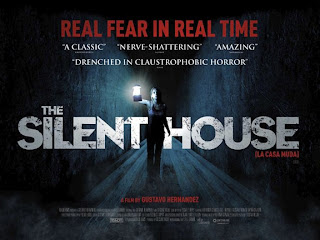
AFED #101: La casa muda [The Silent House] (Uruguay, 2010); Dir. Gustavo Hernández

Image
Gustavo Hernández's supernatural horror attracted some attention on the festival circuit by virtue of its principal gimmick: it was filmed in a single unbroken handheld shot and takes place in real time. There's nothing new about this; Hitchcock ostensibly did the same thing with Rope (albeit cheating due to the technical limitations of the time) and more recently Alexander Sokurov deployed it with his Russian Ark . It's probably more useful to consider The Silent House in the context of horror's ongoing flirtation with vérité techniques in the pursuit of more authentic and visceral frights; a tradition that stretches from Night of the Living Dead to The Blair Witch Project to Paranormal Activity . Yet despite that the plot harkens back the golden era of Victorian supernatural fiction, with a certain Henry James novella being a particular influence, I suspect. Loosely inspired by real-life events, it tells the story of Laura (Florencia Colucci ), a young woman ...

AFED #98: Blue Sunshine (US, 1978); Dir. Jeff Lieberman

Image
Every now and again I'll hear of a hitherto unknown film that sounds so fascinating that I feel compelled to see it as soon as possible. Although Blue Sunshine only received a cursory reference in a passage about drug-related exploitation movies in Jonathan Ross's The Incredibly Strange Film Book I wasted no time in ordering a copy. And it's a great idea: years after they've graduated a number of college kids begin experiencing some unusual side effects from a type of LSD called Blue Sunshine. It opens with a series of cryptic vignettes of various characters who have been either behaving strangely or experiencing hair loss. The story then begins in earnest with a party in which one of the guest's, apparently perfectly normal, suddenly loses all his hair (it pulls away like a wig) and runs off into the night like a maniac. A short while later he returns on a mindless rampage, killing anybody who crosses his path. In classic thriller style one of the other gu...

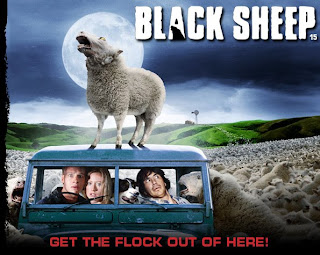
AFED #92: Black Sheep (New Zealand, 2006); Dir. Jonathan King

Image
Just a short review here... I guess if any country was going to produce a horror comedy about genetically engineered vampire sheep then it was going to be New Zealand. What's more surprising is that it's actually not at all bad. Henry Oldfield (Nathan Meister) returns to his family's farm fifteen years after the tragedy that left his father and Henry with a pathological fear of sheep. In the intervening period his ruthless older brother Angus (Peter Feeney) has expanded the estate and, with the assistance of some scientists in his employ, has been conducting some dodgy experiments with his livestock. Henry is all set to sell his share of the farm to Angus and return to his comfortable city life, but when animal rights activists release a mutant vampire lamb they set in motion a train of events that will make Henry's darkest nightmares terrifyingly real. The results are some predictably gory, gruesome and anarchic fun. Given the budget presumably didn't exceed...

AFED #76: La Horripilante bestia humana [aka Night of the Bloody Apes] (Mexico, 1969); Dir. René Cardona

Image
Horror movies tend to treat all science as quackery, it just so happens that all quackery is valid. Transplant surgery, in one form or another, has been the subject of the wildest fantasies ever since Frankenstein ; from the many adaptations of the Shelley story, to The Hands of Orlac , to aberrations like the previously mentioned The Man Without a Body ( AFED #61 ). So even when Christiaan Barnard conducted the first successful human heart transplant in 1967 it was never likely to dampen the zeal for the original Body Horror. Sure enough Night of the Bloody Apes, made not long after, presents a grim reminder of what could go tragically wrong... if only science was a bit less rational. It's your typical mad scientist yarn, albeit with a distinctly Mexican spin. Dr Krellman (José Elías Moreno) decides to conduct the world's ape-to-human heart transplant, in a desperate bid to save the life of his son Julio, who's dying of leukemia. After kidnapping an ape from ...

AFED #71: Cold Light of Day (UK, 1989); Dir. Fhiona-Louise

Image
Sooner or later most infamous real-life crimes receive a dramatisation, but the timing of such treatments can vary enormously. Some cases, such as that of the Moors Murders, are granted a respectful distance (although See No Evil finally told the story for tv in 2006). Others, like that of Harold Shipman, can make it to the screen in just a couple years . American readers will know that over there the turnaround can be even quicker. Perhaps it owes something to the degree to which ordinary, middle-class society is offended or horrified by the crimes, or to what extent they simply feel a morbid curiosity. Film or television executives will seldom commission such a drama if there's any risk of a public backlash, even if it rarely equates to a drop in revenue (far from it). And occasionally independent producers have taken real-life crimes and crafted them into grimly effective films. One of the most notable (if sadly neglected) examples is The Black Panther (1977), a criminal...

AFED #69: Unheimliche Geschichten [Eerie Tales] (Germany, 1919); Dir. Richard Oswald

Image
For those who believed that the horror portmanteau format originated with Ealing's Dead of Night in 1945 might be intrigued to discover this entertaining progenitor from Weimar Germany a quarter of a century earlier. Indeed Unheimliche Geschichten , which shouldn't be confused with a 1932 film of the same name also directed by Richard Oswald, utilises many of what became standard devices in this sub-genre. For starters there's a framing device; set in an antiquarian bookshop, where paintings of three archetypal figures - a Harlot (Anita Berber), the Devil (Reinhold Schünzel), and Death (the great Conrad Veidt) - come to life, much to the terror of the shopkeeper. They proceed flicking through the books, whereupon we embark on a series of five short dramatisations starring the same three actors. In the first of these Veidt plays a man who rescues a young woman (Berber) from her lunatic husband (Schünzel). The pair check into a hotel and Veidt begins contemplating havin...

AFED #67: Gatto Nero [The Black Cat] (Italy, 1981); Dir. Lucio Fulci

Image
Welcome to the sleepy English village of Unspecific, a veritable Babel of different dialects where apparently there are some "ruins", the local policeman's face is adorned with a prodigious caterpillar, and a worrying number of people have been dying violently and inexplicably. Patrick Magee is also a resident, which is never a good sign. Given his rapacious scenery chewing it's probably wise that the locals keep their distance, but they're naturally suspicious why he spends so much time lurking around the cemetery. Magee plays Dr Robert Miles, a medium obsessed by communicating with spirits who resides in a grand gothic pile in the company of an aggressive black cat with whom he has a strange love/hate relationship. The cat may or may not embody the spirit of Magee's dead son, but either way it has an uncanny habit of being in the vicinity when anything nasty takes place. Very loosely adapted from Poe's classic short story, Fulci's entertaining ...

AFED #49: Curse of the Undead (US, 1959); Dir. Edward Dein; The Cabinet of Caligari (US, 1962); Dir. Roger Kay

Image
Another Friday night at the Gothique Society and this time a double bill of American films. Given the growing backlog of unwritten or unfinished reviews on this blog I'll have to keep it brief. First up was Curse of the Undead ; an example of a rarely spotted sub genre: the vampire western. Australian actor Michael Pate stars as Drake Robey, a mysterious gunslinger whose arrival in a small town in the Old West coincides with a spate of mysterious killings. After some misgivings he wins the support of pretty maiden Dolores Carter (Kathleen Crowley), who's inherited the family farmstead after the death of her father and recruits the stranger as a ranch hand. Robey isn't quite so well received by Dolores's beau Dan (Eric Fleming), the local preacher, who conveniently uncovers a diary that may hold the secret to the gunslinger's true nature. Given how certain facets of vampire lore had become a staple of film horror, it's notable that Curse of the Undead ret...

AFED #24: Witchhammer [Kladivo na čarodějnice] (Czechoslovakia, 1969); Dir. Otakar Vávra

Image
At the time of writing, director Otakar Vávra is a month short of celebrating his 100th birthday. Yet even in 1969, when he shot this adaptation of Václav Kaplický's novel of the same name about the Northern Moravia witch trials, he was considered one of Czech cinema's old guard. Witchhammer (or Witches' Hammer , as it's sometimes known) doesn't fit entirely comfortably in the Czech New Wave canon, although Vavra himself was instrumental in the movement. As a lecturer at the state film school FAMU (Film Faculty of the Academy of Dramatic Arts) his open-minded philosophy encouraged the likes of Vera Chytilova ( Daisies )and Jaromil Jireš ( Valerie and Her Week of Wonders ) to innovate and push the boundaries. His own films, taking this as indication, tend towards a more grounded approach, although by no means as reserved as some of his contemporaries. Starkly shot in black and white, Witchhammer tells the story of Boblig von Edelstadt, a ruthless inquisitor ...

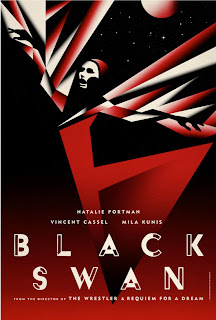
AFED #23: Black Swan (US, 2010); Dir. Darren Aronofsky

Image
The closest I usually get to the ballet is passing a statue of Margot Fonteyn in Reigate on my way to work every morning, so my understanding of it derives almost exclusively from the cinema. Generally the ballet world is depicted as a hotbed of seething emotions and bitter rivalries where egomaniacal artistic directors place their charges under nigh-unbearable pressure to perform. Strangely enough it seems to be a lot like the movie business. Darren Aronofsky's latest film doesn't have any interest in altering that perception; in fact it milks the cliche to glorious effect. As with Powell and Pressberger's 1948 film The Red Shoes the offstage drama becomes an extended metaphor for the ballet's story, in this case Swan Lake. Like its predecessor Black Swan is an overblown melodrama that blurs fantasy and reality, but its portrait of madness is altogether more immersive. Natalie Portman is an actress I've never been enamoured with. It's partially due to hav...

AFED #21: Dead Men are Dangerous (UK, 1938); Dir. Harold French. The Hunchback of Notre Dame (Italy/Frace, 1956); Dir. Jean Delannoy

Image
Now in its 45th season, the Gothique Film Society is a peculiar but quaint anachronism. The Society meets on Friday nights roughly monthly over the winter to screen obscure old horror, crime and suspense films. Many of these films, most regulars would admit, are not very good. I've been attending the Gothique, on and off, for over five years now but am still one of the youngest there. A large number of the membership are pensioners and a few could be politely described as 'eccentric'. Like the dodgy projector (liable to break down at the most inopportune moments) and uncomfortable seats it's all part of the 'Gofeek' experience. As usual tonight's event was a double bill. First up came Dead Men are Dangerous , an above average 'b' movie starring Robert Newton as a struggling and debt-ridden writer who fakes his death by switching his identity with that of a suicide victim. After the police investigation reveals the man's suicide was actuall...

AFED #11: F (UK, 2010); Dir. Johannes Roberts

Image
A few days back in reviewing Seven Green Bottles you may recall I mentioned that the school I attended in Epsom some twenty-odd years ago was mainly populated with straight, middle-class kids largely incapable of any malice or criminality. That was the way it seemed; yet watching today's film I recalled an incident that made the national headlines years after I'd left. One of my old P.E. teachers found himself on the receiving end of a series of abusive telephone calls, including death threats, from two of the boys at the school. The teacher was forced into early retirement from the stress whilst, bizarrely, the boys were for a time allowed to return. It took the intervention of the Education Secretary before their parents agreed to move them to different schools. Such stories aren't unusual these days of course and there have been far more extreme cases. A schoolteacher's life can be a grim and unrewarding one, faced with pupils who can scarcely conceal their co...

AFED #3: Cannibal Holocaust (Italy, 1980); Dir. Ruggero Deodato

Image
A few weeks back I found myself sitting in a pub discussing Video Nasties: Moral Panic, Censorship & Videotape , a documentary released last year about the absurd furore that preceded the implementation of the Video Recordings Act in 1984. Having been only seven/eight years old at the time of the controversy it had largely passed me by and I was asked how I felt about the subject - and the censorship debate it sparked - retrospectively. Being something of a woolly liberal I instinctively adopt an anti-censorship stance. It's not that I disagree that there can ever be grounds for banning or censoring work, but rather in the vast majority of cases I fail to see what's actually being achieved. Provided that children are protected from extreme material - that responsibility surely lies squarely with the parents/guardians - then mature adults should be trusted to make their own decisions. Isn't that the basis of any democratic society? Yet the subject continues to gnaw a...