Posts

Showing posts with the label satire

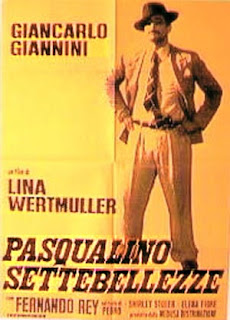
AFED #104: Pasqualino Settebellezze [Seven Beauties] (Italy, 1975); Dir. Lina Wertmüller
Image
Seven Beauties is a film I feel I ought to have liked, or at least appreciated, more than I did. It's an epic, picaresque satire that touches upon subject matter that was still sensitive at the time, but there's an ugliness to it which I found difficult to reconcile. After an introduction that soliloquises ironically about the rise and fall of Mussolini and the indignities of the Second World War over old wartime footage, the story begins in somewhere in Germany shortly after the collapse of Italian fascism. Pasqualino (Giancarlo Giannini) and Francesco are two Italian soldiers fleeing the Nazis. During conversation Pasqualino reveals that he killed a man before the war and the narrative shifts into flashback of his earlier life as a hustler and dandy in Naples, where his life revolved around protecting the honour of his seven sisters. After killing a man who attempted to pimp one of these 'beauties' (they're anything but beautiful) he evades execution by feign...

AFED #103: Limonádový Joe aneb Koňská opera [Lemonade Joe] (Czechoslovakia, 1964); Dir. Oldřich Lipský

Image
I was commenting just a couple of weeks ago (with regard to Sexmission ) how eastern European comedy comes across as very broad and affected to western sensibilities, at least during the Cold war era. Probably the closest we've seen to an English language film done in the same style would, for obvious reasons, be Polanski's The Fearless Vampire Killers , which for all its visual flair and Komeda's wonderful score falls rather flat with the slapstick pratfalls. As I mentioned last time the prominence of this kind of humour probably owed a lot to the censorious climate, where more subversive wit was usually frowned upon. A good example of this is Milos Forman's The Fireman's Ball , which although not especially radical by our standards was criticised in Czechoslovakia for its veiled attack on the petty bureaucracy of communism. No such ire was directed towards Lemonade Joe , which was released a few years earlier; perhaps because it does precisely the opposite ...

AFED #91: Shampoo (US, 1975); Dir. Hal Ashby

Image
Is Shampoo a paean to Warren Beatty's naricissism or a parody? Most likely it's both but the star was assuredly in on the joke. The inspiration for his character, dim-witted bed-hopping hairdresser George Roundy, has been attributed to a number of real life personalities on the sixties L.A. scene; most notably Jay Sebring, who was murdered along with Sharon Tate at the hands of the Manson family. According to writer Robert Towne George was based on another Berverly Hills hairdresser, Gene Shacove, but anyone with a passing knowledge of Beatty's antics during his prime can draw the obvious conclusions. Despite the involvement of Towne and maverick director Hal Ashby it's incontestably Beatty who was its guiding creative force. Beatty's relatively slim output over the years makes it difficult to appreciate just how big a player he was during the late sixties and seventies. Bonnie and Clyde proclaimed the arrival of the new Hollywood and perhaps best encapsulate...

AFED #57: Wild in the Streets (US, 1968); Dir. Barry Shear

Image
It's a reflection of just how vibrant a time the late sixties were, both in the cinema and the world at large, that a film like Wild in the Streets is largely forgotten today. In fact, this tale of a rock star who becomes President actually earned an Oscar nomination for its modish editing. This represented a rare distinction for a film by AIP , a company best remembered today for Roger Corman's Poe adaptations but whose teen-centric productions had grown increasingly more stylish and 'turned on' to the counterculture as the decade continued, with work such as The Wild Angels and The Trip . Although the idea of the euphoria surrounding pop star being exploited for political ends had been explored by Peter Watkins in Privilege the previous year, that film had centred on the notion of the celebrity as a Warholian facade ripe for manipulation. Wild in the Streets offers a premise that's superficially more progressive but ultimately far more reactionary. Max ...